Showing posts with label Week 3. Show all posts

Tuesday, February 9, 2016

Week 3: Brainstorming Storytelling Styles

I have decided to make my story book all about the god Indra. Through my research I have found that Indra was once the supreme god, but somewhere along the course of history he was almost entirely replaced by gods such as Vishnu and Shiva. I think it would be interesting to make a story explaining Indra's fall into obscurity. I also found that Indra was a very unpredictable god that would indulge in his favorite drink, soma, and would go on a rage or do something do wreak havoc. A completely fabricated tale could be made where Indra becomes intoxicated off of soma and causes a natural disaster or does some other mischievous act that causes him to be disliked by his fellow gods and the humans. The most important story that Indra was a part of was his slaying of the demon Vritra, who caused a drought by hording all of the Earth's water for himself. Indra defeated Vritra with the help of his beloved soma and restored the Earth's waters, thus making him a great hero and savior of the Earth. I will most likely make a story that highlights this battle and Indra's rise to fame. There were not very many references to Indra in the Ramayana, but from what I can tell he plays a pivotal role in the Mahabharata. I already created a story about Hanuman's encounter with Indra titled Indra's Sun that I based off of Hanuman's Leap from Myths of the Hindus and Buddhists by Sister Nivedita (1914) in the PDE Ramayana. I will most likely use this story with a few changes since it was one of the only references in the Ramayana.

Image source: Indra on his elephant Airavata.
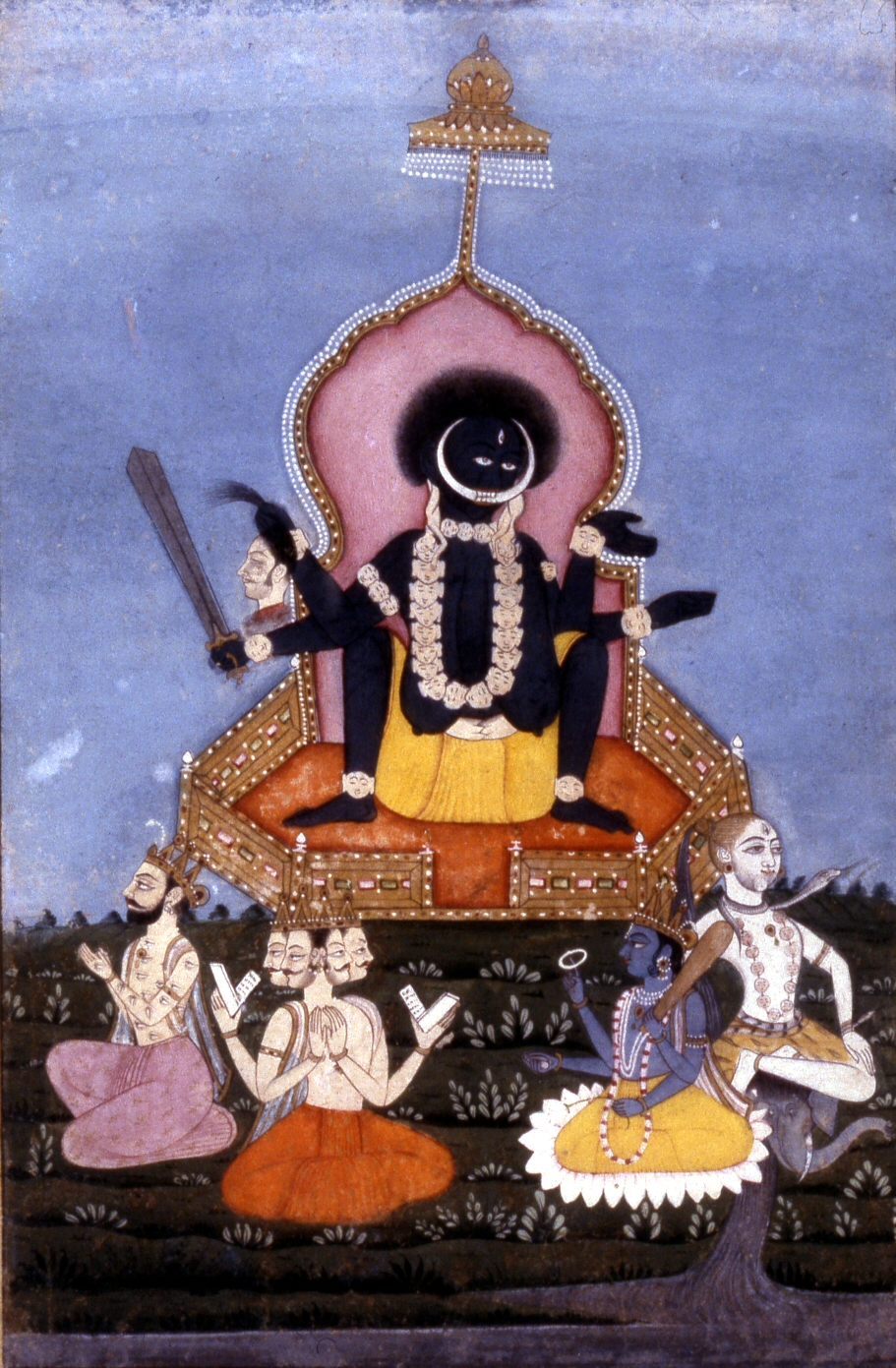

Image Source: Wikipedia. Kali with Indra, Brahma, Vishnu, and Shiva. Walters Art Museum page.


Bibliography:
PDE Ramayana, Various Authors
Hanuman's Leap from Myths of the Hindus and Buddhists by Sister Nivedita (1914)
Mark Cartwright. “Indra,” Ancient History Encyclopedia. Last modified August 08, 2013. http://www.ancient.eu /Indra/.


Possible Styles:

Indra As The Storyteller. I think this style will be interesting because it would give Indra the chance to show that he's not such a bad guy after all. It seems like everyone says he is unpredictable and kind of crazy, but he hasn't gotten the chance to defend himself yet. I could make Indra very narcissistic or I could make him a genuinely nice guy. I like that this style would provide for a completely new way of looking at Indra. 

Therapy Session. This style would sort of go hand in hand with the Indra as the storyteller style. I was thinking that I could use this style for Vishnu or Shiva as the therapist. I could then make Vishnu or Shiva leak the information about Indra's confessions to the public, which would be a reason for Indra falling out of favor in history. 

Characters Grown Old. By using this style I could show what happens to Indra after he is replaced by Vishnu and Shiva. There could be a lot of resentment that Indra holds for Shiva and Vishnu and he could be planning his revenge against them. 

Twist the Ending. I really like making up my own endings to stories. This style would go very well with my writing style because it lets me use a little more creativity. I usually like to make endings that go against what people think would happen. I could use this style as the last story of my storybook and have Indra be killed off, or maybe have Indra kill Vishnu and Shiva but use his godly powers to divide and disguise himself as Vishnu and Shiva. Now that would be interesting!

Friday, February 5, 2016

Week 3 Storytelling: Indra's Sun

It was just another day for Indra, as he mounted his great white elephant and headed to the sky with the sun in tote. Indra has carried the sun into the sky each and every day since the creation of the Earth in order to give light to all of the Earth’s creatures. He took great pride in his responsibility and inevitably developed a strong connection with the sun, which he considered to be one of his most prized possessions. He would polish it every night so that it would never lose its radiant glow.

This day, nothing seemed to be out of the ordinary as he meticulously placed his magnificent orb in its proper location except he couldn’t help but feel that he was being watched. After a careful scan of the Earth below, Indra caught the gaze of a spry young monkey.

This young monkey was Hanuman, who would grow into the king of all monkeys, but that was to be many years in the future. Hanuman marveled at the splendor of this massive golden sphere. He looked longingly at the sun, for he had come to the conclusion that this was a gigantic mango. Hanuman’s mouth began to water with anticipation of the sweet juiciness that a mango of this size would provide. Indra realized that the young monkey had been deceived into thinking that his sun was a fruit and laughed at his foolishness for thinking he could ever jump that high.

Just as his hearty laugh was subsiding, Indra’s amusement turned to shock. Hanuman had taken a great leap several thousand leagues into the sky! Indra could not believe the power this young monkey had, but was even more amazed at the audacity of Hanuman’s attempt to steal HIS sun!

Image source: Hanuman trying to steal the sun

The furious god conjured up an ominous cloud formation and let loose a jagged lightning bolt straight at the impious monkey. Hanuman never saw the bolt since his eyes were transfixed on the glowing mango-like globe. With a thunderous crash, Indra sent Hanuman screaming back to Earth.

Dazed by the strike and with singed fur and a broken jaw, Hanuman finally came to his senses. He looked back into the sky to see a seething Indra, ready to send a second bolt if Hanuman made any further attempt at a theft of his precious sun. Hanuman acknowledged his error and begged for forgiveness from the rightfully furious Indra.

Hanuman’s tear filled words were candid and, although known for his temper and rash judgment, Indra went against his normal ways and forgave the young Hanuman. Indra realized that this was just a youthful mistake and believed the lone lightning strike to be a sufficient punishment.

 Hanuman never forgot his encounter with Indra and never dreamed of crossing him again.


Authors Note:
I chose this story as an expansion of a brief reference made about how Hanuman was able to jump a great distance and should be the one to make the jump to Lanka in order to gather information. This reference was from Myths of the Hindus and Buddhists by Sister Nivedita (1914) in the PDE Ramayana. I wanted to show why Indra intervened at Hanuman's attempt to take the sun, which he thought was a fruit. In this story Indra believes the sun is his and furious that Hanuman tries to steal it. I also, wanted to paint Indra in a more positive light because I have noticed that most sources say that Indra couldn't control his temper. I made Indra a more rational god that was capable of forgiveness without being forced. 


Bibliography:

Wednesday, February 3, 2016

Week 3 Reading Diary, continued: PDE Ramayana

From this weeks continuation of the reading of the PDE Ramayana I have to say that I was shocked by what happened.

The whole Ramayana seemed to have been revving up to the final battle between Rama and Ravana in Lanka. There was a great battle and then the gods sided with Rama to help him destroy Ravana. After Rama claimed victory, he was able to take back Sita. This is where I was completely blown away. Rama denies Sita because she had been living in Lanka with Ravana for a long time! He completely rejects her and doesn't listen to her pleas of innocence. This forces Sita to go through drastic measures to prove her innocence (she decides to have a funeral in fire for herself). Sita is unharmed by the flames, thus proving her innocence. It was later said that Rama knew Sita had done nothing wrong while in Lanka, and that the flames would do nothing to her. He only allowed his love to do this because it was the social norm to do this to your wife if she was suspected of being unfaithful. I was on the edge of my seat just wondering what in the hell was happening and why Rama would act this way if he knew Sita was innocent.

Image Source: Sita being protected from the flames.

I was also really intrigued by the giant battle between all the forces of Rama and Ravana. The part with Rama severing all of Ravana's heads, just to have them grow back, seemed like a great story topic. I could just imagine the shock of Rama as he saw his best shots not being able to vanquish his foe. There was also mention of various weapons being used by both Rama and Ravana, but many of them were not specified.


Tuesday, February 2, 2016

Week 3 Reading Diary: PDE Ramayana

Here is a list of some of my favorite moments from this week's reading of the PDE Ramayana:

I really liked the story where all the monkeys in Sugriva started talking about how far they could jump. Then there was a short background of Hanuman where he once jumped 3,000 leagues when he was a child in order to get to the sun, which he thought was a fruit. Indra (one of my possible storybook topics) was said to have cast Hanuman down and then proceed to through a major fit. Indra is eventually calmed down and gives Hanuman the ability to choose his own death. I would like to expand on why Indra got so angry at Hanuman for trying to steal the sun and what his tantrum caused on the Earth. 

Image source: Hanuman atempting to take the sun 


I also really liked the part where Hanuman goes on a rampage in Lanka. It would have been quite a sight to see a mountain sized monkey with its tail on fire just trampling and burning everything in sight. This reminded me of the cartoon Dragon Ball Z (I was obsessed with this show as a kid) where there is an alien race that would transform into giant apes at the sight of a full moon. I think it would be interesting to tell the story of the giant Hanuman through the eyes of Ravana as he watches his kingdom being burned and trampled to the ground. 

Both of these stories were taken from Myths of the Hindus and Buddhists by Sister Nivedita (1914)